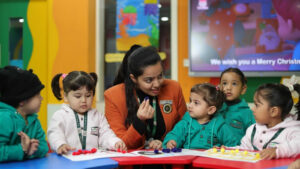
Young students are more likely to remember school routines around things such as lining up if guided play is involved.
“In play, a child is always above his average age, above his daily behavior; in play it is as though he were a head taller than himself.” So wrote Lev Vygotsky, the Russian pioneer of child development and a champion of imaginative play. Researchers have continued to develop this theory, finding that children level up when they “self-distance” or pretend to be someone else. So it makes sense, then, that during the many times in a day when we ask kids to follow directions, we can turn to their imaginations for positive outcomes.